
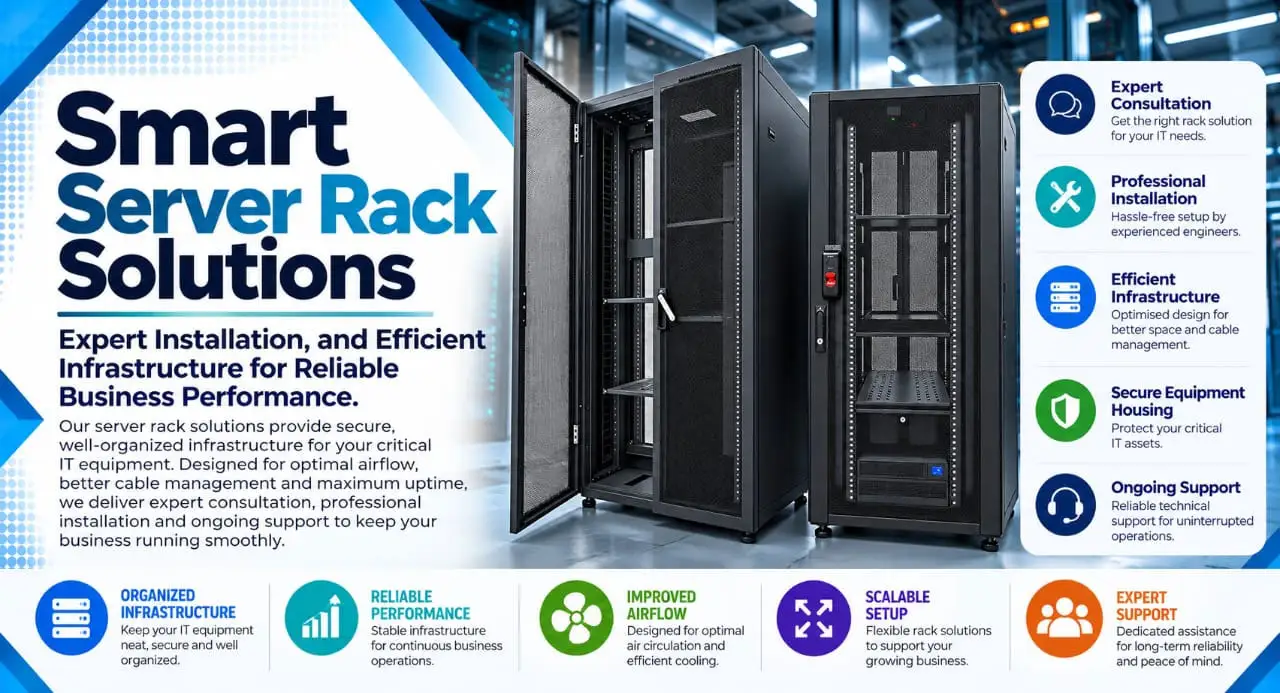
Netshell Smart Server Rack Solutions are designed to support modern IT infrastructure with organized, secure and scalable rack enclosures for data centers, server rooms, network rooms and enterprise environments. These solutions can integrate intelligent power distribution, environmental monitoring, access control and remote monitoring capabilities, depending on the selected configuration, helping businesses improve rack-level visibility and infrastructure management.
With flexible rack configurations and intelligent infrastructure options, Netshell Smart Racks support the organized installation of servers, network switches, storage devices and related IT equipment. Features such as cable management, compatible intelligent PDUs, temperature and humidity monitoring, and optional security integration help organizations develop efficient, manageable and expansion-ready IT environments tailored to their operational requirements.
What We Offer – Netshell Smart Server Rack Solutions
1. Smart Server Rack Solutions
- Intelligent server rack infrastructure for data centers, server rooms, and enterprise IT environments.
- Rack solutions designed to support organized equipment installation and efficient infrastructure management.
2. Server & Network Rack Enclosures
- Floor-standing and wall-mounted rack configurations based on deployment requirements.
- Rack enclosures for servers, switches, storage devices, and networking equipment.
3. Intelligent PDU Integration
- Compatible intelligent Power Distribution Units (PDUs) for rack-level power distribution.
- Configuration options based on equipment load, power requirements, and monitoring needs.
4. Environmental Monitoring Solutions
- Temperature and humidity monitoring options for rack environments.
- Monitoring capabilities to help identify environmental changes that may affect IT equipment.
5. Remote Rack Monitoring
- Compatible monitoring components for improved rack-level visibility.
- Remote access to supported monitoring information, depending on the selected configuration.
6. Access Control & Security Integration
- Access control options to help restrict unauthorized rack access.
- Integration possibilities for CCTV and compatible security monitoring systems.
7. Cable & Thermal Management
- Cable routing and organization to maintain a neat, serviceable rack layout.
- Airflow-conscious equipment arrangement to support effective thermal management.
8. Customized Rack Configuration
- Rack selection based on dimensions, equipment requirements, and available installation space.
- Configuration planning that considers power distribution, monitoring, security, and future expansion.
9. Smart Rack Installation & Deployment
- Assistance with rack installation, equipment integration, and configuration as per project scope.
- Deployment coordination and verification to help ensure the rack setup aligns with operational requirements.
What Are Smart Server Rack Solutions?
Smart Server Rack Solutions are intelligent rack infrastructure systems designed to accommodate servers, switches, routers, storage devices, power distribution units (PDUs) and other essential IT equipment while enabling improved monitoring and infrastructure management.
Unlike conventional server cabinets, smart racks can incorporate intelligent power distribution, environmental sensors, access control and remote monitoring capabilities. These features help IT teams monitor important rack-level conditions, identify potential operational issues and manage equipment more effectively.
Depending on the design and configuration, an intelligent server rack may integrate:
- Intelligent Power Distribution: Supports power distribution to connected IT equipment through compatible PDUs.
- Environmental Monitoring: Monitors conditions such as temperature and humidity through compatible sensors.
- Remote Monitoring: Provides visibility into supported rack parameters through a monitoring interface.
- Access Control: Helps restrict physical access to authorized personnel through compatible access-control systems.
- CCTV Integration: Supports rack or equipment-area surveillance where compatible systems are implemented.
- Cable Management: Helps maintain organized power and network cabling.
- Thermal Management: Supports appropriate equipment airflow and temperature management through suitable rack design and cooling arrangements.
- Scalable Rack Infrastructure: Accommodates changing IT infrastructure requirements through suitable rack sizes and configurations.
The availability of these features depends on the selected rack model, accessories, monitoring components and integration requirements.
Why Businesses Are Investing in Smart Server Rack Infrastructure
As organizations expand their digital operations, the number of servers, network devices and storage systems within their IT environments often increases. Managing this equipment without adequate organization and visibility can make maintenance and troubleshooting more difficult.
Smart Server Rack Solutions help address these requirements by combining structured equipment housing with intelligent monitoring and management capabilities.
1. Improved IT Infrastructure Visibility
Intelligent racks equipped with compatible monitoring systems help IT teams observe selected environmental and power parameters. Better visibility can support faster identification of abnormal conditions and more informed maintenance decisions.
2. Organized Server and Network Equipment
A properly selected server rack enclosure provides a structured environment for installing servers, switches, routers, patch panels, storage equipment and other rack-mountable devices.
Organized equipment placement also supports more systematic cable routing, documentation and maintenance.
3. Better Power Distribution Management
Intelligent PDUs can provide power distribution and, depending on the model, monitoring or switching capabilities. Selecting the appropriate PDU helps organizations align power distribution with the requirements of their IT equipment.
4. Environmental Monitoring Capabilities
Temperature and humidity monitoring can help IT teams understand conditions inside server rooms and rack enclosures. Appropriate sensor placement and alert configuration can support proactive infrastructure management.
5. Enhanced Physical Access Management
Where supported, access-control integration can help organizations manage who is permitted to access rack infrastructure. This is particularly relevant for server rooms, enterprise IT facilities and environments with controlled equipment access.
6. Support for Future Infrastructure Expansion
A scalable rack configuration allows organizations to plan for additional equipment, power requirements, cable capacity and monitoring components as their IT infrastructure evolves.
Key Features of Smart Server Rack Solutions
When evaluating smart server racks, organizations should consider the following features and capabilities.
| Feature | Description | Business Benefit |
|---|---|---|
| Intelligent PDU | Power distribution through compatible rack-mounted units | Organized power delivery and supported monitoring capabilities |
| Environmental Monitoring | Compatible temperature and humidity sensors | Improved visibility into rack conditions |
| Remote Monitoring | Monitoring interface for supported rack parameters | Easier infrastructure supervision |
| Access Control | Compatible electronic or controlled-access mechanisms | Better management of physical access |
| CCTV Integration | Surveillance equipment integration where supported | Additional equipment-area visibility |
| Cable Management | Organized routing of power and network cables | Easier maintenance and troubleshooting |
| Rack Enclosure Design | Floor-standing or wall-mounted rack options | Suitable equipment accommodation |
| Thermal Management | Airflow-conscious rack layout and compatible cooling arrangements | Helps maintain suitable operating conditions |
| Flexible Configuration | Selection of rack size, depth, accessories and monitoring components | Better alignment with project requirements |
| Integration Readiness | Compatibility with selected IT and monitoring components | Supports planned infrastructure deployment |
Important consideration: Not every smart server rack includes all these capabilities as standard. Buyers should verify the exact model specifications, included accessories, monitoring compatibility and integration scope before procurement.
Smart Server Rack Options Available
Smart rack infrastructure is available in multiple configurations. The right option depends on equipment dimensions, installation environment, monitoring requirements and future expansion plans.
1. Intelligent Server Racks
Intelligent server racks combine equipment housing with selected monitoring and power-management components. They are suitable for organizations that require structured IT infrastructure alongside improved visibility into rack-level operating conditions.
Typical applications include enterprise server rooms, branch IT facilities, network infrastructure installations and equipment rooms.
2. Smart Network Racks
Smart network racks are designed to accommodate networking equipment such as switches, routers, patch panels and related accessories.
They can be considered for enterprise networking projects, structured cabling deployments, office IT rooms and distributed network environments.
3. Floor-Standing Smart Racks
Floor-standing racks are suitable for installations requiring dedicated space for servers, network equipment, power distribution and associated accessories.
Available configurations can vary by height, width, depth, load capacity and accessory compatibility. Rack dimensions should be selected according to the equipment being installed and the available site space.
4. Wall-Mounted Network Racks
Wall-mounted enclosures are generally appropriate for smaller network installations, branch offices, retail locations and other environments where floor space is limited.
The selection should account for equipment depth, mounting requirements, ventilation, cable entry and the wall’s ability to support the intended load.
5. Outdoor Server Rack Enclosures
Outdoor enclosures may be required for telecom, surveillance, industrial networking and other deployments exposed to environmental conditions.
Depending on the application, buyers may need to consider enclosure ingress protection, temperature management, corrosion resistance, mounting arrangements and suitable power distribution. An IP rating alone does not establish suitability for every outdoor condition.
6. Smart Racks with Integrated Monitoring
These configurations combine rack infrastructure with compatible sensors and monitoring components to provide visibility into selected environmental or operational parameters.
Organizations should confirm which measurements, notifications, dashboards and remote-access capabilities are supported by the chosen solution.
Introducing Netshell Smart Rack Solutions
Netshell Smart Rack Solutions provide rack infrastructure options for organizations looking to bring together equipment housing, power distribution, environmental monitoring and related infrastructure management components.
Through Radiant Info Solutions Pvt. Ltd., businesses can explore Netshell rack solutions based on their equipment requirements, installation environment, dimensions and desired monitoring capabilities.
The Netshell smart rack concept can bring together the following infrastructure elements, subject to the selected configuration:
- Server and Network Racks: Structured equipment accommodation for servers, networking devices and related hardware.
- Intelligent PDU Integration: Power distribution options aligned with the connected equipment and rack requirements.
- Environmental Monitoring: Compatible sensors for monitoring selected rack conditions.
- Access Control: Options for controlled access where supported by the selected configuration.
- CCTV and Remote Monitoring: Integration possibilities for suitable surveillance and monitoring components.
- Cable Management: Infrastructure arrangements to support organized cable routing.
- Thermal and Airflow Management: Rack selection and layout considerations that support suitable equipment operating conditions.
- Flexible Rack Configurations: Options for different equipment capacities, dimensions and installation environments.
- Infrastructure Integration Support: Assistance with identifying suitable components and planning rack deployment.
For organizations comparing intelligent server rack solutions in India, the focus should be on selecting a configuration that meets current requirements without creating unnecessary complexity or limiting future expansion.
Netshell Smart Rack Applications
Smart server racks can support a variety of IT and networking environments.
| Industry or Environment | Typical Application |
|---|---|
| Data Centers | Server accommodation, rack-level power distribution and monitoring |
| Enterprise Offices | Centralized networking and server infrastructure |
| Banking and Financial Services | Structured IT equipment housing and controlled access |
| Education | Network infrastructure for campuses and institutions |
| Healthcare | Organized infrastructure for supported IT and network systems |
| Telecom and Networking | Equipment housing for network and communication devices |
| Manufacturing | Network infrastructure in suitable industrial environments |
| Retail and Distributed Offices | Compact rack installations for branch-level IT systems |
| Surveillance Infrastructure | Rack accommodation for compatible networking and recording equipment |
The suitability of a specific rack depends on the equipment specifications, environmental conditions, security requirements and deployment design.
How to Select the Right Smart Server Rack
Before purchasing a smart server rack or network enclosure, businesses should evaluate the following factors.
1. Rack Size and Dimensions
Determine the required rack height in rack units (U), width and depth. Check the dimensions of servers, switches, storage systems and other components to ensure sufficient clearance and compatibility.
2. Equipment Load Capacity
Evaluate the total installed equipment weight and confirm that the rack’s rated load capacity is suitable for the intended installation.
3. Power Requirements
Calculate the connected equipment’s power demand and identify suitable PDU specifications, input connections, outlet types and electrical ratings. Redundancy requirements should also be considered where applicable.
4. Monitoring Requirements
Decide which parameters need monitoring, such as temperature, humidity or supported power measurements. Confirm the availability of compatible sensors, software, connectivity and alerting functionality.
5. Physical Security
Determine whether the installation requires lockable doors, electronic access control, access logging or compatible CCTV integration.
6. Cooling and Ventilation
Assess equipment airflow requirements, rack placement and the existing cooling arrangement. The rack design should support the intended airflow rather than obstruct it.
7. Site and Installation Conditions
Check available floor space, wall-mounting requirements, cable entry points, equipment access and maintenance clearance before finalizing the configuration.
8. Future Scalability
Allow for anticipated equipment additions, cable capacity, PDU requirements and monitoring expansion wherever practical.
9. Deployment and Support
Confirm delivery, installation, configuration, testing and post-deployment support requirements with the selected solution provider.
Smart Server Rack Price in India: What Determines the Cost?
Businesses researching smart server rack prices in India should compare complete configurations rather than relying solely on the rack cabinet’s base specifications.
The overall quotation may depend on:
- Rack height, width, depth and construction.
- Equipment load capacity and enclosure design.
- Intelligent PDU specifications and quantity.
- Environmental sensors and monitoring components.
- Access-control and CCTV integration requirements.
- Cable-management accessories and other rack components.
- Cooling and airflow requirements.
- Installation, configuration and commissioning scope.
- Delivery location and project-specific requirements.
A customized quotation should clearly distinguish the rack enclosure, optional accessories, intelligent components, integration work and deployment services.
Radiant Info Solutions can help businesses evaluate their requirements and request a suitable Netshell smart rack configuration and commercial proposal.
Smart Server Rack Installation and Deployment Process
A structured deployment approach helps ensure that the selected rack is compatible with the equipment and intended operating environment.
Step 1: Requirement Assessment
Review the application, equipment inventory, rack dimensions, power needs and monitoring expectations.
Step 2: Rack Configuration Selection
Identify the suitable rack type, enclosure dimensions, mounting arrangement and accessories.
Step 3: PDU and Monitoring Planning
Determine the required power distribution components, sensors, monitoring interface and other compatible integrations.
Step 4: Site Readiness Assessment
Check installation space, electrical provisions, cooling arrangements, network connectivity and equipment access.
Step 5: Delivery and Installation
Coordinate the rack delivery, positioning, mounting where applicable and installation according to the approved project scope.
Step 6: Equipment and Cable Organization
Arrange equipment and route cables in accordance with equipment requirements and the deployment plan.
Step 7: Configuration and Testing
Validate the installed components and test the supported monitoring, power distribution and access-control functions.
Step 8: Handover and Documentation
Provide agreed deployment documentation, configuration information and operational guidance.
The actual activities will depend on the project scope and the selected Netshell rack configuration.
Why Choose Radiant Info Solutions for Netshell Smart Rack Solutions?
Radiant Info Solutions Pvt. Ltd. supports businesses in evaluating and implementing IT infrastructure solutions aligned with their operational requirements.
Organizations exploring Netshell smart racks can seek assistance with:
- Requirement-Based Product Selection: Identify suitable rack types, dimensions and accessories.
- Infrastructure Planning: Align rack selection with server, network and storage equipment.
- Intelligent Component Coordination: Assess compatible PDU, monitoring and access-control requirements.
- Project Coordination: Coordinate relevant vendors and deployment activities within the agreed scope.
- Installation and Deployment Support: Plan implementation, configuration and testing according to project requirements.
- Enterprise Procurement Assistance: Support product evaluation and quotation coordination.
- Scalable Infrastructure Planning: Consider future equipment additions and monitoring requirements.
- Multi-Vendor IT Infrastructure Expertise: Coordinate rack infrastructure with other relevant IT components.
- Pan-India Project Support: Coordinate suitable delivery and service resources for projects across India, subject to availability and agreed scope.
Our objective is to help organizations select practical rack infrastructure that meets their technical, operational and expansion requirements.
Request a Quote for Netshell Smart Server Rack Solutions
Whether you are planning a new server room, upgrading network infrastructure or exploring intelligent rack monitoring, selecting the right configuration is an important step toward an organized and manageable IT environment.
Radiant Info Solutions Pvt. Ltd. can assist with evaluating Netshell Smart Rack Solutions based on your preferred rack dimensions, equipment requirements, power distribution needs and monitoring objectives.
Contact Radiant Info Solutions to discuss your smart server rack requirements and request a customized quotation for supply, integration and deployment support in India.
Share your project details, preferred rack size, installation location and required intelligent features to help identify a suitable solution.
Frequently Asked Questions (FAQs) – Netshell Smart Server Rack Solutions
What are Netshell Smart Server Rack Solutions?
Netshell Smart Server Rack Solutions are designed to accommodate servers, networking devices, storage systems and other IT equipment, with options for intelligent power distribution, environmental monitoring and infrastructure management based on the selected configuration.
What features are available in Netshell Smart Racks?
- Intelligent PDU integration for power distribution.
- Temperature and humidity monitoring options.
- Remote monitoring of supported rack parameters.
- Access control and compatible CCTV integration.
- Cable management and airflow-conscious rack configurations.
Feature availability depends on the selected model and accessories.
What types of smart server racks are available?
Options may include floor-standing server racks, wall-mounted network racks, intelligent rack configurations and specialized enclosures for specific installation environments. The appropriate solution depends on equipment dimensions, capacity and deployment requirements.
Can I get a customized smart server rack configuration?
Yes, rack selection can be planned around your required height, width, depth, equipment load, power distribution needs, monitoring requirements and available installation space.
Do Netshell Smart Racks support intelligent PDUs?
Compatible configurations can support intelligent Power Distribution Units (PDUs). Depending on the selected PDU, features may include power monitoring, remote management or outlet-level control.
Can Netshell Smart Racks monitor temperature and humidity?
Temperature and humidity monitoring can be incorporated through compatible sensors and monitoring components. Confirm the supported measurements and alerting capabilities for the selected configuration.
Are Netshell Smart Server Racks suitable for data centers?
Smart rack configurations can be considered for data centers, enterprise server rooms, network infrastructure facilities and other IT environments, subject to equipment capacity, power requirements, cooling arrangements and site conditions.
What factors determine smart server rack prices in India?
Pricing depends on rack dimensions, construction, load capacity, PDU specifications, monitoring components, security accessories and installation requirements. Requesting a configuration-specific quotation helps establish the appropriate cost.
Do Netshell Smart Racks support access control and security integration?
Compatible configurations may support controlled access and CCTV integration. Available options depend on the selected rack design and the security components being implemented.
How do I choose the right server rack size?
Consider the number and dimensions of your devices, rack-unit requirements, equipment depth, total load, cable routing, airflow and potential future expansion. Verify equipment compatibility before finalizing the rack.
Can smart server racks be integrated with existing IT infrastructure?
Integration may be possible with existing servers, network equipment, power distribution systems and monitoring components. Compatibility should be assessed before implementation to ensure the selected equipment works together as intended.
Is installation and deployment support available for smart server racks?
Installation and deployment services may include rack positioning, equipment organization, cable management, component integration, configuration and testing, depending on the agreed project scope and service availability.
What should I consider before purchasing a smart server rack?
Evaluate rack dimensions, equipment load, PDU requirements, monitoring features, physical security, ventilation, installation conditions, compatibility and future scalability.
How can I request a quotation for Netshell Smart Server Rack Solutions?
Share your required rack dimensions, equipment list, power requirements, desired monitoring features and delivery location with the sales team to obtain a suitable configuration recommendation and quotation.
What are the benefits of choosing intelligent server rack solutions?
- Improved organization of servers and network equipment.
- Better visibility into supported rack-level parameters.
- Structured power distribution and cable management.
- Options for environmental monitoring and physical access control.
- Greater flexibility for future IT infrastructure expansion.
